

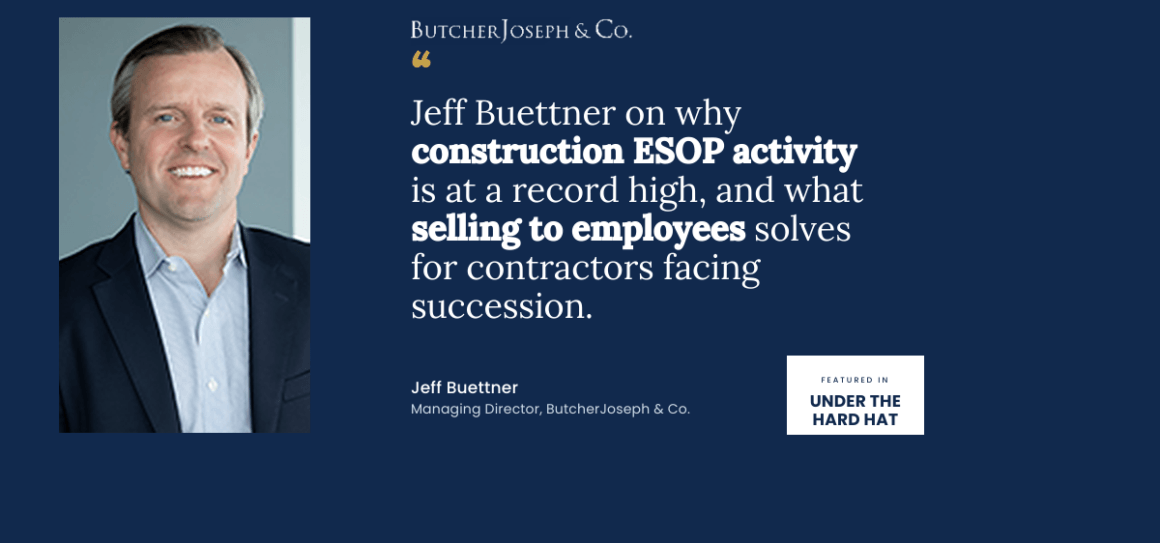
Jeff Buettner on Construction’s ESOP Surge in Under the Hard Hat
ButcherJoseph & Co. Managing Director Jeff Buettner was recently featured in Under the Hard Hat, where he discussed why a growing number of contractors are selling to their own employees rather than to a competitor or a private equity buyer.
The volume is the story. Jeff told the publication that construction ESOP activity is at the highest level he has seen, with most of the acceleration coming in the past three to four years. The sector was already concentrated: construction companies account for roughly 18 to 20 percent of private-company ESOPs nationally, according to the National Center for Employee Ownership, one of the largest concentrations of employee ownership in the economy.
The reason is operational. A contracting business is its superintendents, project managers, estimators, and craft workforce, and the value a buyer underwrites depends on whether that organization stays intact after the owner leaves. Jeff notes that an ESOP gives employees a stake tied to company performance, which helps contractors recruit and retain without leaning entirely on wages. Continuity also protects the mechanics of the business itself, including surety relationships, licenses tied to qualifying individuals, backlog already under contract, and long-standing client teams.
The tax treatment matters as well. A qualifying C-corporation owner may be able to defer capital gains on a sale of stock to an ESOP, and an ESOP-owned S-corporation may avoid federal income tax on the share of earnings attributable to ESOP-owned stock, which leaves more cash in the business to bid and invest. Jeff illustrated the seller side with a simplified example: at a 10x EBITDA sale and a hypothetical 40 percent tax rate, proceeds net to roughly 6x, while a qualifying deferral can preserve the full 10x. Deferral is not elimination, and qualifying requires meeting specific conditions. ESOPs also carry setup and valuation costs, acquisition debt, and a long-term obligation to repurchase shares from departing employees, so they are not a fit for every company.
The article cites Western Specialty Contractors, the national specialty and restoration firm founded in 1915, which became employee-owned in February 2026 in a transaction ButcherJoseph advised.
Jeff expects construction ESOP volume to keep rising through 2026 and 2027, with the pace depending on how individual markets perform. Infrastructure and data center demand is drawing investor interest and firming pricing in certain segments, and a softer demand picture would likely push some owners to wait.
About ButcherJoseph & Co.
ButcherJoseph & Co. is a boutique investment banking firm specializing in sale transactions to strategic and financial buyers, employee ownership transactions (ESOPs), capital advisory (debt & equity), valuations and fairness opinions and ESOP strategic consulting. ButcherJoseph is headquartered in St. Louis with a presence in Austin, Charlotte, Chicago, Miami, Philadelphia, Scottsdale, and Washington, D.C.
ADDITIONAL RESOURCES