


Building the Workforce: Why Skilled Labor Is Driving Construction M&A
For most of the past decade, conversations about construction M&A centered on familiar themes: backlog quality, end-market exposure, equipment fleets, and geographic footprint. Those fundamentals still matter. But as we move through 2026, a different dynamic has taken hold, and it is reshaping how buyers evaluate targets and how owners should think about the value of their businesses.
The most contested asset in construction today is the workforce itself.
A Structural Shortage, Not a Cyclical One
The labor gap in construction is well documented, but the scale is worth restating. Associated Builders and Contractors estimates the industry needs roughly 349,000 net new workers in 2026, and another 456,000 in 2027, beyond normal hiring and replacement levels.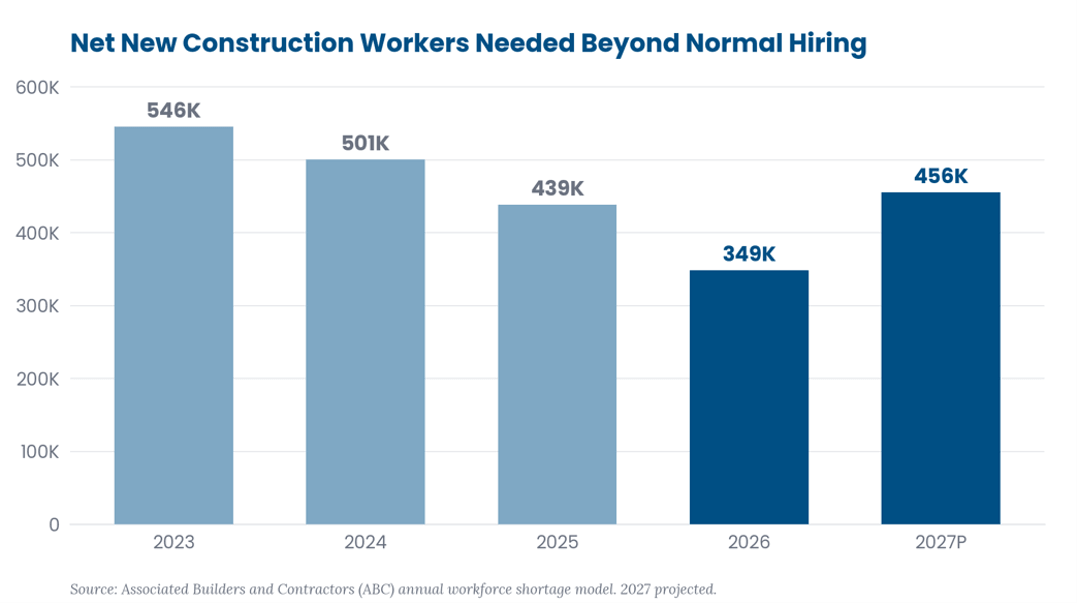
What makes those figures more striking is what sits behind them. Much of the demand is not being driven by new projects at all. It reflects a wave of retirements among foremen, superintendents, and craft professionals that has been building for years. The average construction worker in the U.S. is over 42 years old, and only a small fraction of the workforce is under 35.
At the same time, demand for construction services has not slowed to meet the labor supply. Data center and power infrastructure work continues to absorb enormous amounts of specialty trade capacity, particularly in electrical and mechanical. Census Bureau data put data center construction at a $50.7 billion annualized rate in April 2026, up from $39.8 billion a year earlier. Manufacturing reshoring and public infrastructure spending add further pressure.
The result is a market where labor, not demand, sets the ceiling. Unfilled construction positions topped 224,000 in mid-2026, pushing the construction job openings rate to 3.5 percent from 2.6 percent a year earlier. A contractor with a strong pipeline can still leave work on the table if the field cannot support it. That is a meaningful shift. For years, the question was how much work a firm could win. Increasingly, the question is how much work a firm can staff.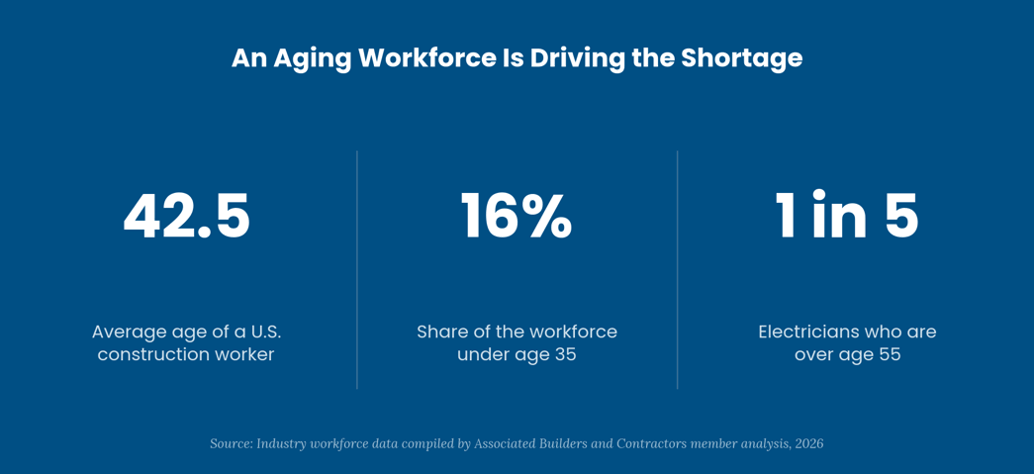
Acquisitions as a Workforce Strategy
When organic hiring cannot close the gap, acquisition becomes the fastest reliable path to capacity. This is now one of the defining features of construction M&A.
Buyers are increasingly acquiring subcontractors and specialty trade firms not primarily for their revenue, but for their crews. A single transaction can deliver experienced field teams, licensed tradespeople, an established safety culture, and seasoned project leadership that would take years to develop through recruiting alone. The trend is most pronounced in the trades where competition for talent is fiercest: electrical, mechanical, HVAC, and concrete.
The deal data reflects this. Construction services M&A expanded for the third consecutive year in 2025, with more than 560 announced or closed transactions, an increase of over 18 percent from the prior year.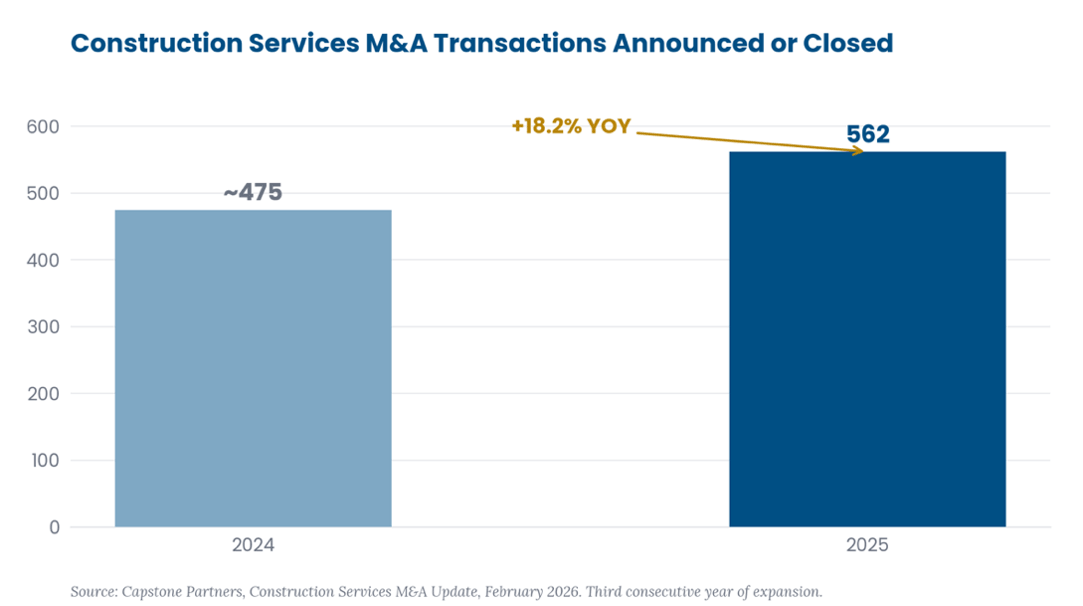
Private equity remains the most active buyer group, pursuing buy-and-build strategies across specialty contractors and engineering firms. For these buyers, the setup is compelling: a fragmented industry, durable demand, and a scarce input. Every add-on acquisition compounds workforce capacity alongside revenue.
The premium in today’s market attaches to people.
What This Means for Valuation
For owners of well-run contractors, the labor shortage has quietly become a valuation tailwind. Buyers are underwriting things that do not always show up cleanly on a balance sheet: low field turnover, deep apprenticeship pipelines, strong benches at the foreman and superintendent level, and documented training programs. A contractor that can demonstrate it retains its people and develops the next generation of craft leadership is worth more than an otherwise identical firm that cannot.
Diligence has changed accordingly. Workforce metrics now receive the same scrutiny once reserved for backlog and bonding capacity. Tenure distributions, wage competitiveness, safety records, and succession depth in field leadership all factor into how buyers price risk. Owners who come to market with clear, well-organized workforce data are better positioned to defend a premium. Those who cannot tell that story will find buyers discounting for the uncertainty.
Retention Risk Is Deal Risk
There is a flip side that deserves attention as well. If the workforce is the asset, then attrition is the risk. A construction acquisition where key crews walk out the door after closing can destroy the very value the buyer paid for. Sophisticated buyers are structuring around this with retention arrangements, earnouts tied to workforce stability, and integration plans designed to preserve the culture that kept people in place.
This is one reason employee ownership continues to gain traction in the industry. Nearly 1,000 construction companies now operate as ESOPs, covering more than 200,000 employee-owners. In a market defined by labor scarcity, ESOPs offer something few other structures can: a direct alignment between the company’s performance and the people who deliver it in the field. Contractors that have transitioned to employee ownership frequently report stronger retention and recruiting outcomes, precisely because employees hold a stake in the outcome. A 2026 survey by the National Center for Employee Ownership found voluntary quit rates at ESOP companies averaged 11 percent, against roughly 26 percent across U.S. companies generally, and 85 percent of respondents said employee ownership improved their ability to attract and keep people. For a founder weighing succession options, an ESOP can preserve the workforce continuity that buyers now pay a premium for, while still delivering fair market value and meaningful tax advantages to selling shareholders.
The Question for Owners
None of this suggests the labor shortage will resolve soon. The demographic math is not favorable, and training infrastructure takes years to scale. This is a structural constraint that will shape competition, margins, and deal activity well beyond the current cycle.
For business owners, the implication is clear. The people on your payroll have become one of the most valuable and most scrutinized assets in any transaction. Whether the path forward is a sale, a recapitalization, or a transition to employee ownership, workforce strength belongs at the center of the value story, documented and presented with the same rigor as financial performance.
The question is not whether skilled labor is scarce. That is now an established reality. The more important question is whether your company can prove it attracts, develops, and keeps skilled people, because in this market, that proof is what commands the strongest outcomes.
ADDITIONAL RESOURCES